
Christopher Cheetham
CEO | Ptera Technologies
Clients are increasingly pushing back on pricing from technology services and consulting firms with a simple question:
If you are using AI, why does this still cost so much?
It is a fair challenge. But it rests on an assumption that does not hold up particularly well in complex, regulated sectors:
faster delivery does not automatically mean lower-value work.
AI is already changing how work gets done. It can speed up research, compress drafting cycles, accelerate coding, and improve testing throughput. Good firms should use it. Clients should expect them to use it.
But that does not mean the economics of high-quality delivery suddenly collapse.

There is a tendency to talk about AI as though it is a near-free layer of efficiency. In practice, that is not how serious delivery teams experience it.
Model usage has a real cost base, especially when teams are working across:
Yes, AI can reduce time spent on some tasks. But it can also introduce meaningful operating costs of its own. In many cases, what it really does is allow firms to deliver more, test more, and refine more within the same delivery window.
That is not the same as “the work should cost much less.”
Historically, a meaningful share of a technology consulting mandate was spent not on building, but on defining what should be built in the first place. In many cases, roughly 20–35% of the work sat in requirements shaping, solution design, architecture, stakeholder alignment, and identifying risks or edge cases early. In fintech and other regulated sectors, that percentage was often even higher, because the real challenge was not just technical feasibility, but whether the solution would actually be acceptable to bank partners, card networks, compliance teams, and other institutional stakeholders.
The more important point is that the highest-value part of most technology and consulting work is not raw production.
It is judgement.
In sophisticated sectors, the central question is rarely just:
Can this be built?
It is more often:
Can this be built in a way that will survive contact with the real world?
That distinction matters enormously in fintech.
A model may help generate a technically plausible solution. It will not reliably tell you whether that solution is likely to be accepted by a sponsor bank. It will not consistently identify where a card network may have concerns. It will not naturally understand how a compliance team, enterprise customer, or regulator is likely to react to a particular workflow, control design, or product feature.
That is where sector expertise still does the heavy lifting.

Some of the most valuable advice in fintech is not about what is technically possible. It is about what is commercially viable, operationally supportable, and institutionally acceptable.
That includes knowing:
This is precisely the kind of judgement clients are paying for.
It is also the kind of judgement that generic AI output cannot replace yet.
AI can help generate code quickly. That is useful. But speed of generation is only one small part of real delivery.
Strong technical execution still depends on people who know how to build for the right outcome.
That means understanding:
In regulated environments, ‘it works’ is not a particularly high bar.
The work has to stand up to scrutiny. It has to perform under pressure. It has to be supportable, defensible, and robust enough for real institutions to rely on.
That still requires experienced people.
Clients should absolutely expect technology services firms and consultants to use AI intelligently.
They should expect:
But they should not assume that AI removes the need for:
The best firms are not being paid simply to move faster. They are being paid to make better decisions, avoid costly mistakes, and deliver work that holds up outside the pitch deck, the prototype, or the demo environment.
AI is changing delivery. That is real.
But in high-stakes sectors like fintech, the value of expert services was never just in producing output quickly. It was in knowing what to build, how to build it, what to avoid, and what will actually work in the market.
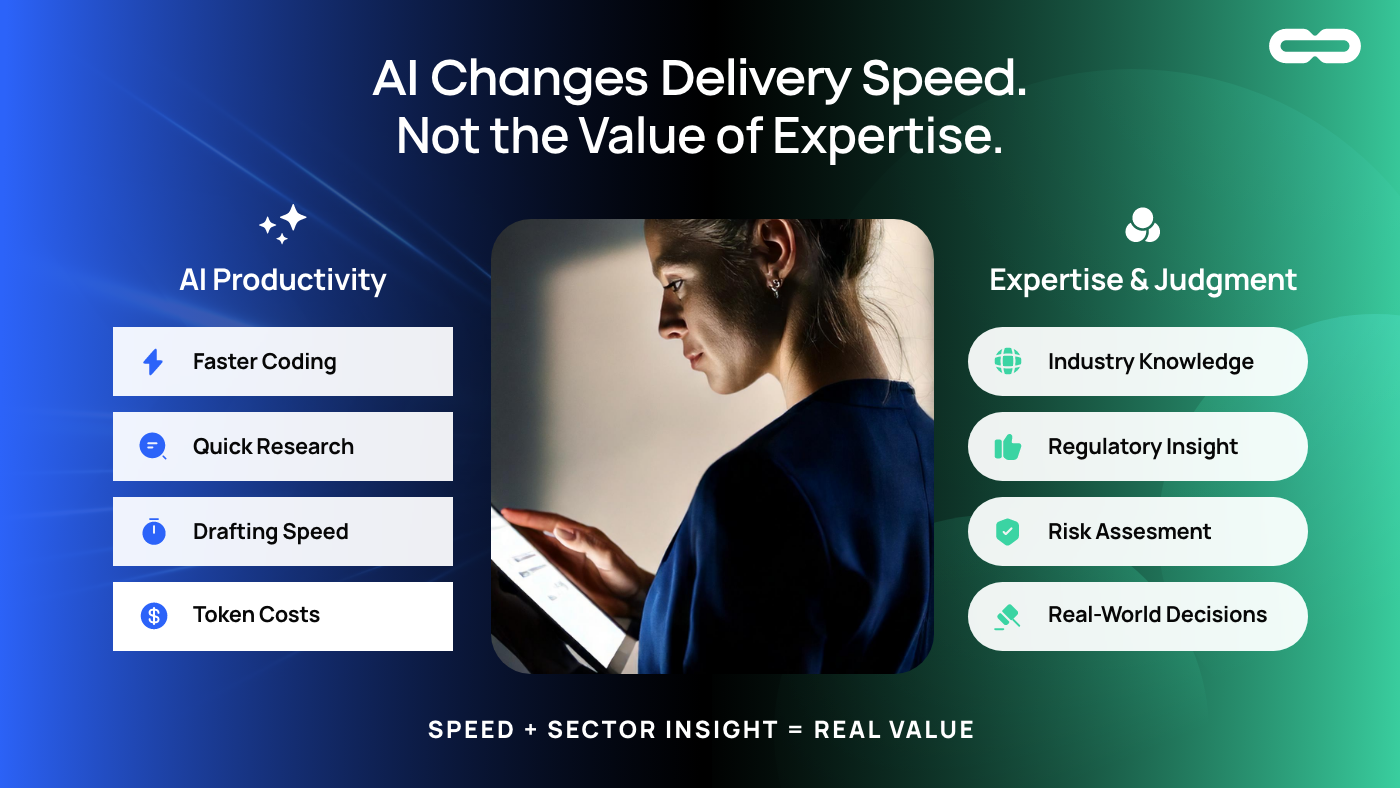
AI changes delivery speed.
It does not change the value of expertise.
www.ptera.tech